Why India Is the World's Pharmacy: The Secrets Behind Its Pharma Dominance

India Pharma Cost & Impact Estimator
Explore how India's integrated supply chain and scale drive down medication costs. Enter your details below to estimate savings.
By sourcing from India, you support a system that supplies ~20% of world's generics and ~50% of global vaccines. The savings generated can often fund additional treatments for low-income populations via organizations like the Global Fund.
Enter data to see estimated cost benefits.
You likely have at least one pill in your medicine cabinet right now that was made in India. Maybe it’s a painkiller, an antibiotic, or a blood pressure medication. It’s not just a guess; it’s a statistical reality. India supplies roughly 20% of the world’s generic medicines and nearly half of all vaccines used globally. But why? Why did this specific country become the global hub for pills and potions while others faded into niche markets?
The answer isn’t magic. It’s a perfect storm of history, policy, chemistry, and sheer scale. If you’ve ever wondered how a company in Hyderabad can produce a drug for pennies that costs dollars elsewhere, you’re asking the right questions. Let’s break down the real reasons behind India’s pharmaceutical powerhouse status.
The History That Built the Foundation
To understand today’s dominance, you have to look back to the mid-20th century. Before the 1970s, India’s drug market was dominated by foreign multinational corporations. These companies held patents on almost everything, meaning they could charge whatever they wanted. This left millions of Indians unable to afford basic healthcare.
In 1970, the Indian government made a bold move. They changed patent laws to recognize only process patents, not product patents. What does that mean? It meant that if a company in India could figure out a different way to make a drug already sold abroad, they didn’t have to pay royalties to the original inventor. This legal loophole sparked a revolution. Local manufacturers started reverse-engineering popular drugs. They didn’t need to invent new molecules; they just needed to find cheaper ways to replicate existing ones. This era laid the groundwork for the massive generic industry we see today.
The Cost Advantage: More Than Just Cheap Labor
People often assume India is cheap because labor is cheap. While wages are lower than in the US or Europe, that’s only part of the story. The real cost savings come from integrated supply chains and economies of scale.
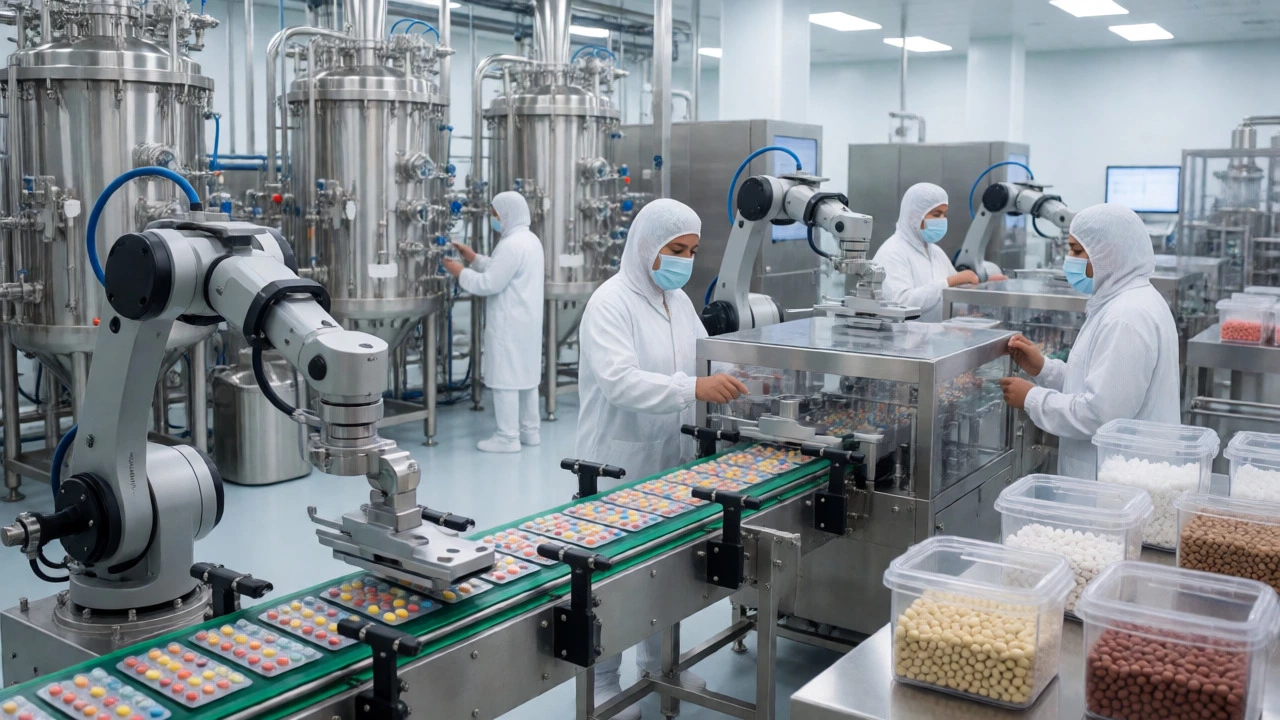
India produces its own Active Pharmaceutical Ingredients (APIs). APIs are the raw chemical components that make a drug work. In many countries, manufacturers have to import these ingredients from China or Europe, adding shipping costs and tariffs. In India, especially in hubs like Gujarat and Andhra Pradesh, the entire ecosystem exists in one place. You have the chemical plants making the APIs, the factories formulating them into tablets, and the packaging units ready to go. This vertical integration slashes logistics costs significantly.
Consider this: producing a standard tablet in India can cost up to 40% less than in Western countries. For life-saving drugs like antiretrovirals used for HIV treatment, this difference is monumental. It allows organizations like the Global Fund to buy more doses with the same budget, saving countless lives.
Regulatory Mastery and Quality Standards
A common misconception is that "cheap" means "low quality." That stereotype died decades ago. Today, India has the highest number of US FDA-approved facilities outside the United States. As of recent data, over 500 Indian plants hold FDA approval. That’s more than any other country except the US itself.
How did they achieve this? Indian companies invested heavily in compliance. Companies like Sun Pharma, Dr. Reddy’s, and Cipla realized early on that to export to wealthy nations, they had to meet strict Good Manufacturing Practices (GMP). They hired top scientists, built state-of-the-art labs, and adopted rigorous testing protocols. Now, when a batch leaves a factory in Mumbai, it undergoes scrutiny comparable to any facility in New Jersey or Basel.
This regulatory rigor opens doors. Once a company gets FDA approval, it can sell products in the US, Canada, and Europe. It also builds trust with buyers in Africa and Asia who rely on Indian generics for their public health systems.
The Talent Pool: Engineers and Chemists Galore
Pharmaceuticals aren’t just about mixing chemicals; they’re about precision engineering and complex chemistry. India graduates hundreds of thousands of science and engineering students every year. Many of them specialize in pharmacy, chemical engineering, and biotechnology.
This abundance of talent keeps R&D costs low. When a Western company wants to develop a new formulation or improve a manufacturing process, they often partner with Indian Contract Research Organizations (CROs). These firms handle the grunt work of clinical trials and data analysis at a fraction of the cost. This outsourcing model accelerates innovation globally. It’s a symbiotic relationship: Western firms get speed and savings, while Indian firms gain exposure to cutting-edge research methodologies.
Moreover, the English proficiency among Indian professionals smooths communication. There’s no language barrier when discussing complex molecular structures or regulatory submissions. This ease of collaboration makes India a preferred destination for global partnerships.
Scale and Volume: The Power of Mass Production
Imagine running a machine that produces 10 million tablets a day versus one that produces 100,000. The per-unit cost drops dramatically with volume. India’s domestic market is huge-over 1.4 billion people. This internal demand ensures that factories are always running at full capacity. They don’t need to wait for export orders to keep the lights on.
This high-volume production creates a buffer against price fluctuations. When raw material prices spike, large-scale producers can absorb the shock better than smaller competitors. They negotiate better rates with suppliers because they buy in bulk. This competitive pricing power extends to international markets, allowing Indian exporters to undercut rivals without sacrificing margins.
| Factor | Impact on Industry | Global Consequence |
|---|---|---|
| Process Patents (1970) | Allowed local replication of foreign drugs without royalty fees. | Birth of the generic drug sector. |
| Integrated API Supply Chain | Reduced dependency on imports and lowered production costs. | Stable global drug prices. |
| FDA Compliance | Enabled access to premium Western markets. | High-quality standards for global consumers. |
| Skilled Workforce | Lowered R&D and operational costs. | Faster global drug development cycles. |

Challenges and Future Outlook
It’s not all smooth sailing. India faces challenges too. Environmental regulations are tightening, especially around waste disposal in chemical clusters. Some states have faced backlash from local communities concerned about pollution. Additionally, there’s a growing push to move from generics to innovative drugs. Currently, most Indian output is copies of expired patents. To stay relevant, companies must invest in discovering new molecules, which is risky and expensive.
However, the momentum is strong. The government’s "Make in India" initiative continues to offer incentives for pharma investments. Foreign Direct Investment (FDI) limits have been relaxed, encouraging global giants to set up shop in India. We’re seeing more collaborations between Indian startups and big pharma for novel therapies in oncology and immunology.
If you’re looking at the future of medicine, keep an eye on India. It’s not just about cheap pills anymore. It’s about becoming a center for affordable innovation. As healthcare costs rise worldwide, the model India perfected-high quality at low cost-becomes even more valuable.
Frequently Asked Questions
Is medicine from India safe to take?
Yes, generally speaking. Major Indian pharmaceutical companies adhere to strict international standards, including those set by the US Food and Drug Administration (FDA) and the European Medicines Agency (EMA). Many Indian factories undergo regular inspections to ensure they meet Good Manufacturing Practices (GMP). However, as with any source, buying from reputable pharmacies ensures you get genuine products.
Why are Indian drugs so much cheaper than American drugs?
The primary reason is the lack of patent monopolies for older drugs. Because India recognized process patents rather than product patents historically, local manufacturers could produce generic versions of branded drugs without paying licensing fees. Additionally, lower labor costs, integrated supply chains for raw materials, and massive production volumes contribute to significantly lower overheads compared to Western manufacturers.
What percentage of global medicines comes from India?
India supplies approximately 20% of the world's generic medicines by volume. It is also the largest provider of generic drugs to the United States, accounting for about 40% of generic prescriptions filled there. Furthermore, India produces nearly half of the world's vaccines, playing a critical role in global immunization programs.
Do Indian companies only make generic drugs?
While generics form the bulk of India's pharmaceutical output, the landscape is changing. Leading Indian companies are increasingly investing in research and development to create novel drug formulations and biosimilars. Some are moving toward developing new molecular entities, though this remains a smaller portion of their portfolio compared to traditional generics.
Which cities are known for pharmaceutical manufacturing in India?
Key hubs include Hyderabad (often called the "Genome Valley"), Ahmedabad and Vadodara in Gujarat, Baddi in Himachal Pradesh, and Mumbai/Pune in Maharashtra. These regions benefit from established infrastructure, skilled labor pools, and supportive state policies for industrial growth.