What Does Manufacturing Do for the Economy?
Manufacturing Impact Calculator
Calculate Manufacturing Impact
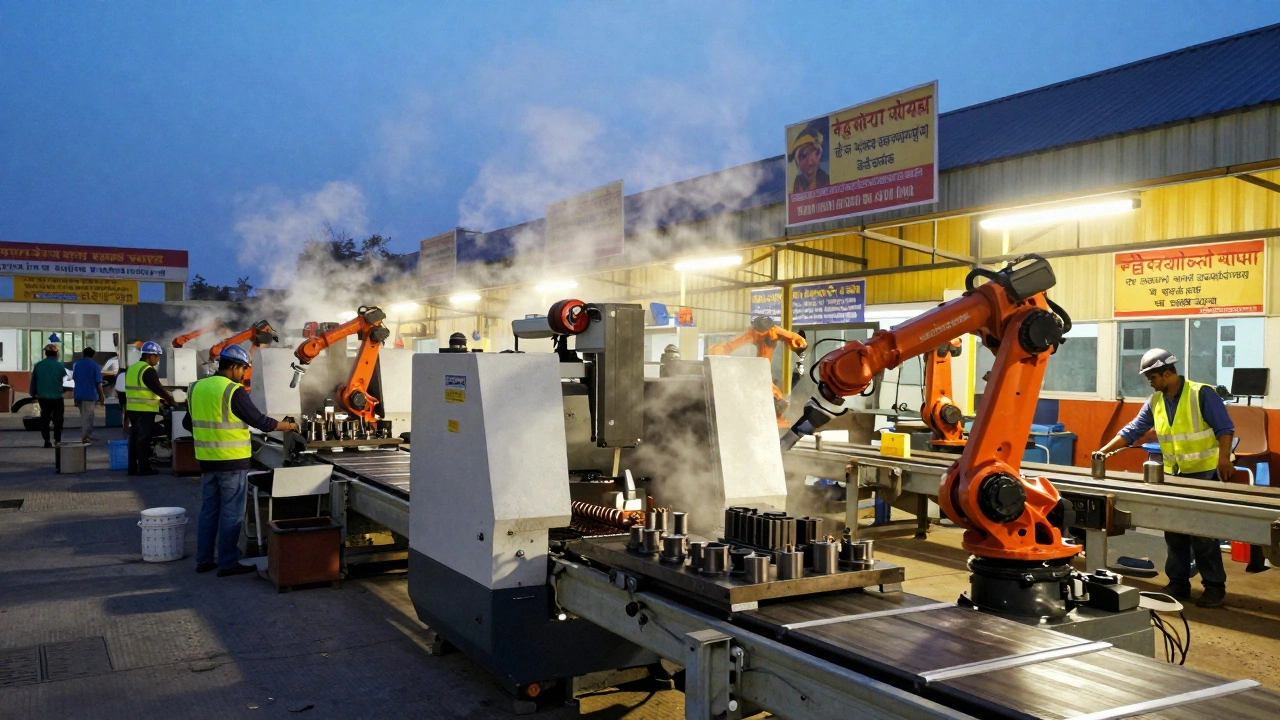
Manufacturing doesn’t just make things-it builds economies. In countries like India, where millions rely on factories, workshops, and assembly lines, manufacturing is the backbone of growth. It’s not just about producing smartphones, textiles, or auto parts. It’s about lifting entire communities out of poverty, creating stable jobs, and giving local businesses a chance to thrive. If you’ve ever wondered why governments pour billions into factories and industrial zones, the answer is simple: manufacturing moves money, people, and opportunity in ways few other sectors can.
It Creates Jobs-Lots of Them
Every factory needs workers. Not just engineers and managers, but welders, machine operators, quality inspectors, logistics coordinators, and cleaners. In India alone, manufacturing employed over 40 million people in 2025. That’s more than the entire population of Canada. These aren’t temporary gigs. Factory jobs often come with benefits, steady paychecks, and paths to advancement. A worker who starts as a machine assistant can become a team lead in five years. That kind of upward mobility doesn’t happen often in casual labor markets.
And it’s not just direct jobs. For every job in a factory, there are two or three more in supporting industries. Think truck drivers hauling raw materials, electricians installing machinery, software developers building inventory systems, and local shops selling meals to night-shift workers. Manufacturing doesn’t just create jobs-it multiplies them.
It Drives Innovation and Skills
When a company starts making something new, it doesn’t just buy machines. It trains people. Workers learn how to operate CNC machines, read blueprints, troubleshoot robotic arms, and follow strict safety standards. These aren’t basic skills-they’re technical, transferable, and valuable. A worker trained in automotive assembly in Pune can later work in electronics manufacturing in Chennai or even move abroad.
Manufacturing pushes education too. Vocational schools and industrial training institutes have sprung up across Tamil Nadu, Gujarat, and Uttar Pradesh. These aren’t fancy universities, but they’re where real skills are built. The government’s Skill India initiative, for example, trained over 12 million people in manufacturing-related trades between 2020 and 2025. That’s not charity-it’s investment. Skilled workers attract more factories. More factories mean more demand for training. It’s a cycle that lifts everyone.
It Strengthens the Supply Chain
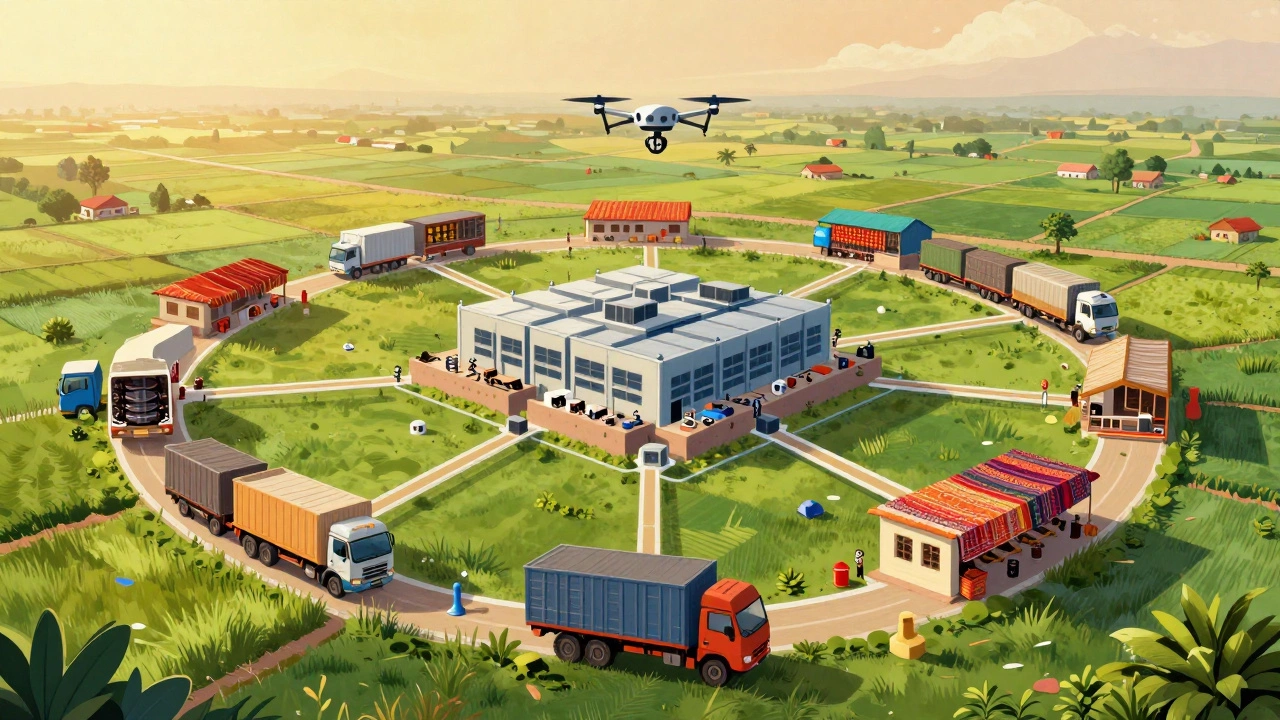
Manufacturing pulls everything together. A single smartphone might need 800 parts from 20 different suppliers. Those parts come from steel mills, plastic molders, circuit board makers, and battery plants-all of them local or regional. When you build a factory, you don’t just create one business. You create a network.
In India, the Make in India campaign helped small suppliers in Ludhiana, Tiruppur, and Coimbatore grow into medium-sized enterprises. One metal stamping unit in Ahmedabad went from supplying three local firms to exporting to Germany after being integrated into a larger electronics assembly chain. That’s the power of manufacturing: it turns small players into critical links in global supply chains.
It Boosts Exports and Reduces Imports
When a country makes its own goods, it doesn’t have to buy them from overseas. That saves foreign currency. In 2025, India’s manufactured exports hit $420 billion-up from $280 billion in 2020. That’s not just revenue. It’s economic independence.
Think about it: before 2020, India imported over 70% of its medical devices. Today, thanks to local production in Gujarat and Karnataka, that number has dropped to under 40%. The same is true for solar panels, textiles, and even electric scooters. When you produce at home, you keep money inside the country. That money gets reinvested-into more factories, better roads, schools, and hospitals.
It Attracts Investment
Foreign companies don’t move factories to places with bad roads and unreliable power. They go where the ecosystem is ready. India’s manufacturing growth has drawn billions from Apple, Samsung, Toyota, and Siemens. Why? Because they see a workforce that’s trained, a government that’s offering tax breaks, and suppliers that are ready to scale.
When Apple moved its iPad production from China to India in 2023, it didn’t just bring jobs. It brought new technology, better quality control systems, and international standards. Local suppliers had to upgrade their machines and software to meet Apple’s demands. Now, those same suppliers serve other global brands. That’s the ripple effect.
It Builds Infrastructure
Factories don’t appear out of nowhere. They need roads, power plants, water treatment, and internet connections. When the government sets up an industrial corridor-like the Delhi-Mumbai Industrial Corridor-it doesn’t just build factories. It builds highways, rail links, and smart grids.
These aren’t just for manufacturers. Farmers in Haryana now get electricity 20 hours a day because of new substations built for nearby factories. Villages near industrial zones get better mobile networks because telecom companies expanded coverage to serve factory workers. Infrastructure built for manufacturing ends up serving everyone.
It Helps Balance Regional Inequality
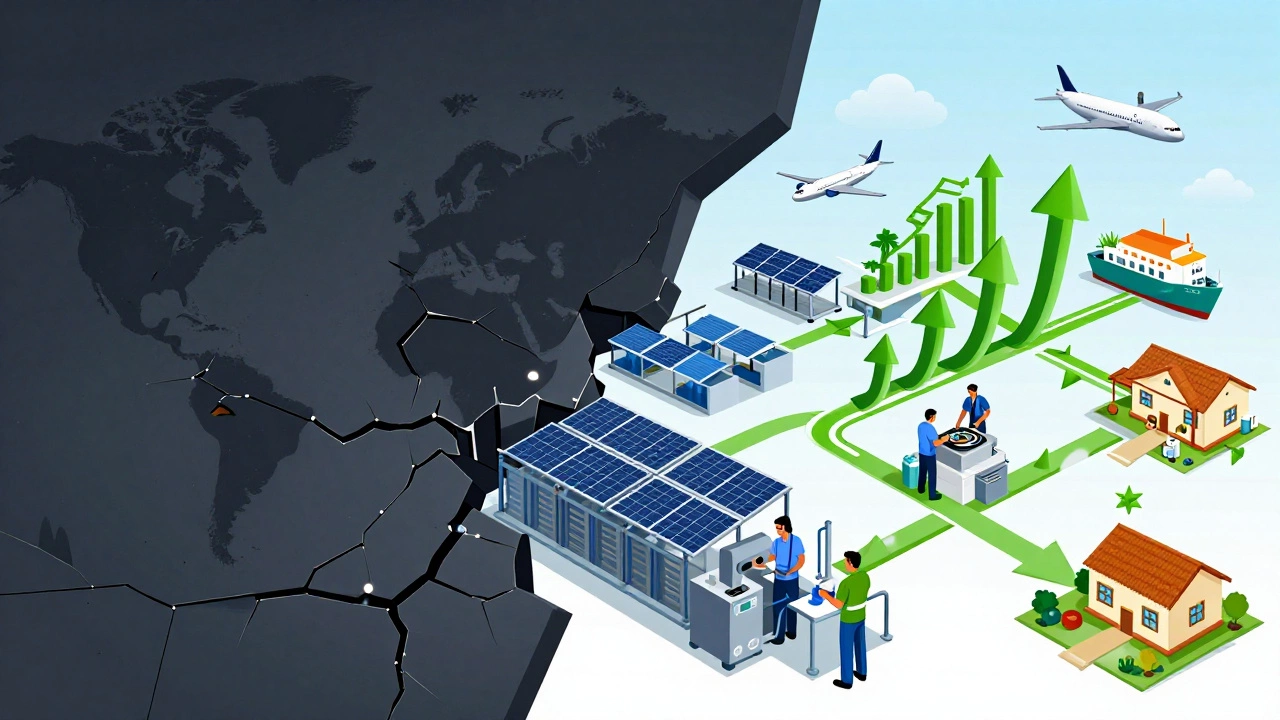
For decades, India’s economy was centered in Mumbai, Delhi, and Bangalore. But manufacturing is changing that. New industrial parks in Odisha, Jharkhand, and Madhya Pradesh are drawing young workers away from overcrowded cities. In 2025, nearly 40% of new manufacturing jobs were created outside the top five states.
That’s huge. It means families don’t have to uproot themselves to find work. It means local talent stays local. And when young people find good jobs at home, they start businesses-repair shops, canteens, transport services-further boosting the local economy.
It Makes the Economy More Resilient
When global supply chains broke down during the pandemic, countries that relied on imports struggled. India faced shortages of medicines, electronics, and even masks. But because it had already started building domestic manufacturing capacity, it bounced back faster than most.
Today, India produces over 90% of its generic medicines and 60% of its medical oxygen equipment locally. That didn’t happen by accident. It happened because the government offered incentives, reduced red tape, and gave manufacturers access to cheap credit. That resilience isn’t just about survival-it’s about control. When you make your own essentials, you’re not at the mercy of global politics or shipping delays.
It Fuels the Next Generation of Startups
Manufacturing doesn’t just create jobs-it creates entrepreneurs. Once you’ve worked in a factory, seen how machines work, understood supply chains, and learned how to negotiate with suppliers, you start thinking: ‘I could do this better.’
That’s why India now has over 2,000 manufacturing startups. Some make custom metal parts for electric vehicles. Others produce affordable solar lanterns for rural homes. One company in Bengaluru even recycles plastic waste into construction blocks. These startups didn’t come from tech incubators alone. They came from factory floors.
Manufacturing gives people the tools, knowledge, and confidence to build their own businesses. And that’s how economies truly grow-not just from big corporations, but from thousands of small, determined owners.
How does manufacturing affect small businesses?
Manufacturing gives small businesses a steady stream of customers. A local machine shop might supply parts to a nearby electronics factory. A printing company might make labels for packaged goods. These relationships turn small shops into essential parts of larger production chains. When manufacturing grows, so do these small suppliers-often faster than retail or service businesses.
Why do governments offer tax breaks to manufacturers?
Tax breaks aren’t giveaways-they’re investments. A factory that gets a 10-year tax holiday might hire 500 workers, buy $20 million in local materials, and export $100 million worth of goods over that time. The government loses tax revenue upfront, but gains far more in income tax from workers, GST from suppliers, and economic activity from new businesses that open around the factory. The return on investment is high.
Does manufacturing harm the environment?
Old factories did. But today’s manufacturing is changing. India’s new industrial zones require solar power, water recycling, and zero liquid discharge systems. Factories now pay for emissions, not just output. The government’s Green Manufacturing Scheme, launched in 2024, gives subsidies to companies that cut energy use by 30% or more. The goal isn’t to stop manufacturing-it’s to make it cleaner.
Can automation replace manufacturing jobs?
Yes, but not as fast as people think. In India, automation is mostly used for repetitive, dangerous tasks-like welding or lifting heavy loads. But most manufacturing still needs humans for quality checks, maintenance, and customization. A robot can’t fix a misaligned screw on a medical device. A human can. That’s why, even with robots, manufacturing jobs are growing-just changing. Workers are shifting from manual labor to tech-assisted roles.
What’s the difference between manufacturing and assembly?
Assembly is putting together parts made elsewhere. Manufacturing is making those parts from raw materials. A company that assembles smartphones buys screens, chips, and batteries from suppliers. A manufacturer makes the circuit boards, molds the plastic casing, or refines the metals. Manufacturing creates more value, more jobs, and more skills. That’s why governments push for full manufacturing-not just assembly.
Manufacturing isn’t glamorous. It’s loud, sweaty, and often overlooked. But it’s the quiet engine behind nearly every improvement in living standards over the last century. From better medicine to affordable phones to reliable electricity, manufacturing turns ideas into reality. And in a world where supply chains are fragile and economies are shifting, the country that builds things-really builds them-will be the one that thrives.