What Are Unit Operations in Food Processing? A Simple Breakdown
Pasteurization Safety Calculator
Food Safety Requirements
Pasteurization must meet specific temperature-time combinations to kill harmful bacteria. Based on FDA and USDA guidelines for common food products.
Safety Assessment
Ever wonder how milk becomes yogurt, or how raw potatoes turn into frozen fries? It’s not magic. It’s unit operations. These are the basic building blocks of every food factory, from small local kitchens to massive plants that feed entire countries. Think of them like the steps in a recipe-but scaled up, standardized, and run 24/7.
What Exactly Is a Unit Operation?
A unit operation is a single, physical step in food processing that changes the form, condition, or location of the food. It doesn’t change the chemical makeup-that’s called a unit process. Unit operations are mechanical, thermal, or physical. They’re the reason your orange juice tastes the same every time, no matter where you buy it.
These steps are designed to be repeatable, measurable, and controllable. In a lab, you might mash an apple by hand. In a factory, you use a pulper that processes 10 tons an hour. Same goal. Different scale. That’s a unit operation.
Common Unit Operations in Food Processing
Here are the most common ones you’ll find in any food plant:
- Size reduction - Grinding, milling, chopping. Think flour from wheat, or powdered spices. This increases surface area, which helps with mixing, cooking, or extracting flavors.
- Size enlargement - Pelletizing, granulation, agglomeration. Used to turn powders into easy-to-handle granules, like instant coffee or baby formula.
- Separation - Filtering, centrifuging, sedimentation. Removing solids from liquids, like skimming cream from milk or clarifying fruit juice.
- Mixing and blending - Combining ingredients evenly. Think dough in a bread factory or seasoning in a bag of chips. Poor mixing leads to inconsistent taste or safety risks.
- Heating and cooling - Pasteurization, sterilization, freezing. Kills harmful bacteria, extends shelf life, and locks in texture. Milk pasteurized at 72°C for 15 seconds is a classic example.
- Evaporation and drying - Removing water to preserve food. Concentrated tomato paste, powdered milk, and dried fruit all rely on this.
- Extraction - Pulling out oils, flavors, or nutrients. Cold-pressed olive oil or caffeine extracted from coffee beans are both results of extraction.
- Transportation - Moving food from one step to the next. Pumps, conveyors, pipelines. Sounds simple, but clogs or spills can shut down a whole line.
Why Unit Operations Matter
Without unit operations, food processing would be chaotic. Imagine trying to pasteurize 50,000 liters of milk using a pot on a stove. Impossible. Unit operations make large-scale food production safe, efficient, and consistent.
They also control quality. If the temperature during pasteurization drops by even 2°C, harmful bacteria might survive. If the mixer doesn’t blend spices evenly, some bags of seasoning could be too salty, others too bland. That’s why factories monitor each unit operation with sensors, timers, and automated controls.
Unit operations also affect cost. A poorly designed drying system might use twice as much energy as an optimized one. That’s thousands of pounds wasted every year. Engineers spend years improving these steps-not just to make food, but to make it cheaper and greener.
Real-World Examples
Let’s follow a simple product: tomato sauce.
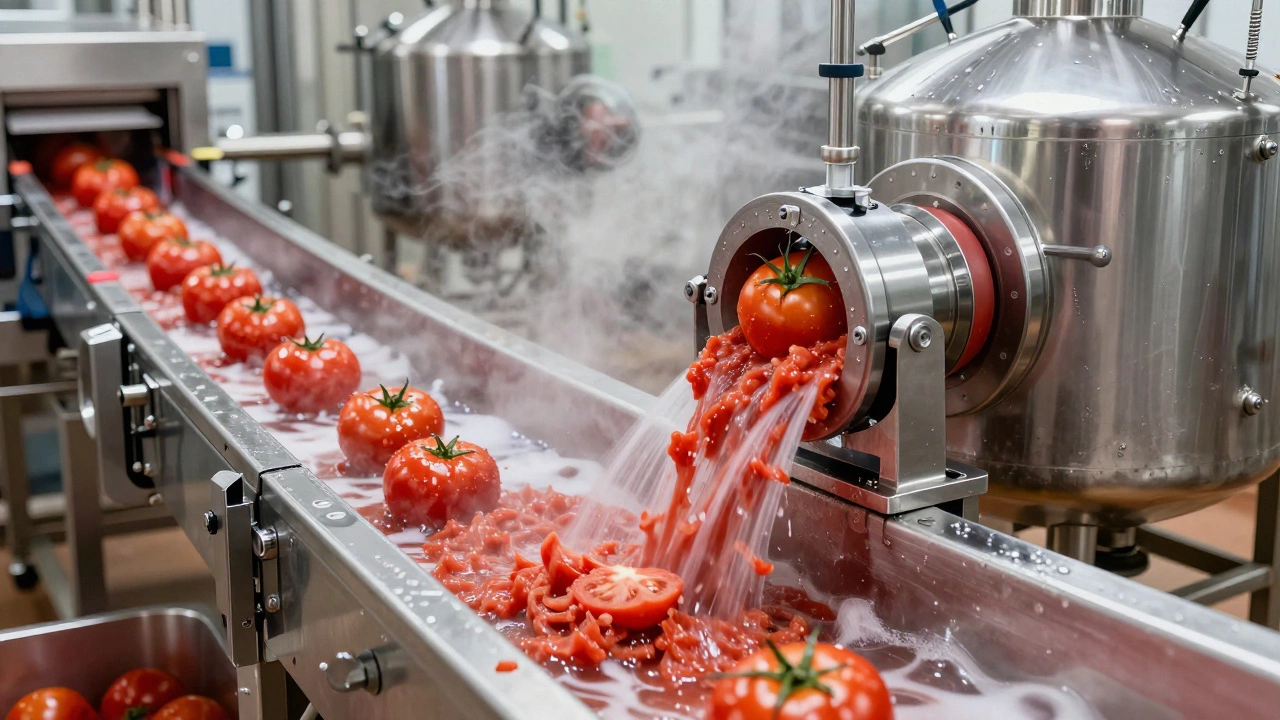
- Receiving and washing - Tomatoes arrive by truck and are sprayed with water to remove dirt and pesticides.
- Size reduction - They go through a crusher that breaks them into pulp.
- Heating - The pulp is heated to 85°C to soften it and kill microbes.
- Separation - Seeds and skins are removed using a screen or centrifuge.
- Evaporation - Water is boiled off to thicken the sauce into a concentrated form.
- Mixing - Salt, sugar, and spices are blended in.
- Packaging - The sauce is filled into jars, sealed, and sterilized again.
Each of those steps is a unit operation. Change one, and the final product changes. Too much heat in step 3? Flavor burns. Not enough evaporation? Sauce is too watery and spoils fast.
How Unit Operations Are Designed
Food engineers don’t just pick steps randomly. They use principles from physics, chemistry, and biology to design them. For example:
- Heat transfer equations determine how long to pasteurize a liquid.
- Fluid dynamics help size pumps so they don’t damage delicate ingredients like yogurt cultures.
- Mass balance calculations track how much raw material enters and how much product leaves-no room for waste.
They also consider the food’s properties. A fruit puree behaves differently than a batter or a powder. Engineers test viscosity, density, and thermal conductivity to pick the right equipment. A centrifuge that works for orange juice won’t work for thick tomato paste.
Unit Operations vs. Unit Processes
Don’t confuse unit operations with unit processes. Operations change physical form. Processes change chemical structure.
Example: Fermentation. When bacteria turn milk into yogurt, that’s a unit process. It’s a biological reaction. But the step before it-cooling the milk to 42°C so the bacteria can work-is a unit operation. It’s just temperature control.
Most food products need both. Yogurt needs the unit operation of cooling, then the unit process of fermentation, then another unit operation: packaging in sterile containers.
What Happens When Unit Operations Fail?
When a unit operation breaks down, the consequences aren’t just financial-they’re dangerous.
In 2019, a Canadian dairy plant had a faulty pasteurizer. The temperature sensor failed. Thousands of liters of milk were never heated to safe levels. The result? A listeria outbreak. Dozens hospitalized. One death.
Or take a snack company that skipped proper drying. Moisture stayed in the chips. Mold grew. Product recall. Brand ruined.
That’s why every unit operation has safety margins, backup systems, and regular maintenance. A food plant doesn’t just make food. It manages risk.
How Technology Is Changing Unit Operations
Modern factories use smart sensors and AI to monitor every step in real time.
- Cameras detect broken pieces in cereal before packaging.
- AI adjusts drying times based on humidity and batch size.
- Robot arms handle fragile items like eggs without cracking them.
Even small changes add up. One UK bakery reduced energy use by 18% just by optimizing the timing of their oven cycles. That’s not just saving money-it’s cutting carbon emissions.
Automation doesn’t replace people. It frees them up to focus on quality control, troubleshooting, and innovation.
Final Thoughts
Unit operations are the invisible backbone of the food you eat every day. You don’t see them, but you taste their results-consistent flavor, safe ingredients, long shelf life.
Whether you’re making jam in your kitchen or running a factory that supplies supermarkets, understanding these steps helps you make better food. They’re not just engineering tricks. They’re the reason we can trust what’s in our groceries.
Next time you open a carton of juice or grab a bag of frozen veggies, remember: dozens of precise, controlled steps got it there. That’s the power of unit operations.
Are unit operations only used in large food factories?
No. Even small-scale producers use unit operations. A local jam maker who heats fruit, strains seeds, and bottles the product is doing the same steps as a big company-just with smaller equipment. The principles are identical. Scaling down doesn’t change the science.
Can unit operations be done at home?
Yes, in basic forms. Blending soup is mixing. Boiling vegetables is heating. Straining broth is separation. Drying herbs on a rack is evaporation. Home cooks naturally use unit operations. The difference is scale and precision. Factories use sensors and automation; you use your eyes and a timer.
What’s the most important unit operation in food safety?
Pasteurization and sterilization. These heating steps kill harmful bacteria like Salmonella, E. coli, and Listeria. Without them, many foods-especially dairy, juices, and canned goods-would be unsafe to store or ship. This is why food safety regulations require strict temperature and time controls for these operations.
Do unit operations affect nutrition?
Yes, but it’s not always bad. Heating can destroy some vitamins, like vitamin C, but it can also make other nutrients more available. For example, cooking tomatoes increases lycopene absorption. Freezing preserves nutrients better than canning. The key is controlling the operation-time, temperature, and method matter.
How do you choose the right equipment for a unit operation?
You start by understanding the food’s physical properties: viscosity, density, heat sensitivity, and particle size. Then you match the equipment to those needs. A high-shear mixer for thick sauces, a plate heat exchanger for liquids, a fluidized bed dryer for powders. It’s not about buying the fanciest machine-it’s about choosing the right tool for the job.